Putting the Human Back in the Process
Design Thinking isn’t just for designers; it is a strategic mindset for any leader facing “wicked problems.” It is a human-centered approach to innovation that draws from the designer’s toolkit to integrate the needs of people, the possibilities of technology, and the requirements for business success.
At LeanSparker, I teach FMCG teams to move away from “Analytical Overload” and toward “Creative Confidence.” By embracing this methodology, you ensure that your Innovation Management is grounded in reality, protecting your Market Insights from being clouded by internal assumptions.
Quick Navigation
- What is Design Thinking? The five-stage non-linear loop.
- The Glossary: Ideation, Divergent Thinking, and HMW.
- The Strategy: The “Double Diamond” Framework.
- The 3-Step Playbook: Applying Design Thinking to services.
- The Solutions: 6 Mechanisms for team-based innovation.
- Watch-Outs: Avoiding “Analysis Paralysis.”
- The Creative Pulse: Deep insights for innovation leaders.
Assess Your Knowledge Of Innovation
The Innovation IQ Test: What Lean Sparker Are You?
Ready to assess whether you have the foundational knowledge of innovation used by top industry leaders? Take this fast, 5-question quiz to instantly measure your expertise in Lean Startup, Design Thinking, and building a Growth Mindset.
Definition: What Exactly is Design Thinking?
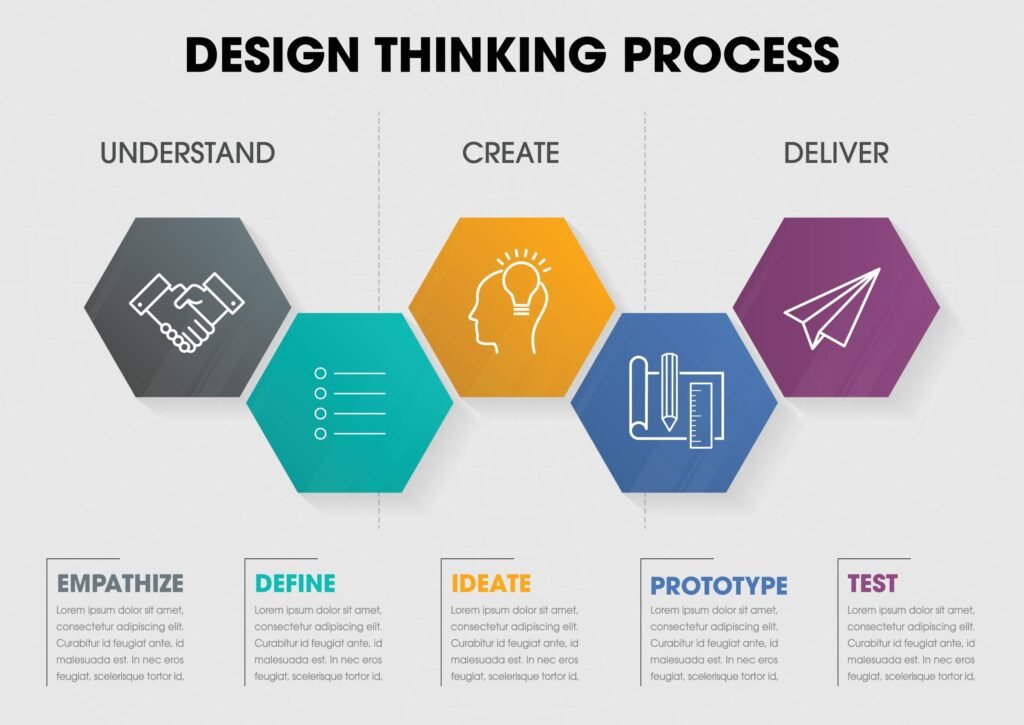
Design Thinking is a solution-based approach to solving problems. It is particularly useful in tackling complex issues that are ill-defined or unknown by understanding the human needs involved. For a Swiss FMCG brand, it might mean rethinking the “Unboxing Experience” to reduce waste while increasing the sense of luxury. For a service company, it could mean redesigning a “Customer Support” flow to prioritize empathy over efficiency.
This process is deeply linked to User-Centered Design (UCD) and User Empathy. It encourages organizations to focus on the people they’re creating for, which leads to better products, services, and internal processes.
Understanding the Design Thinking Glossary
To lead an innovation sprint, you must speak the language of design:
Divergent Thinking: Exploring as many possibilities as possible (quantity over quality initially).
Convergent Thinking: Narrowing down choices to the most viable solution.
HMW (How Might We?): A framing technique used to turn a problem into an opportunity for design.
Ideation: The process of generating a broad range of ideas without judgment.
Point of View (POV): A meaningful and actionable problem statement based on user insights.
The Strategy: The Double Diamond
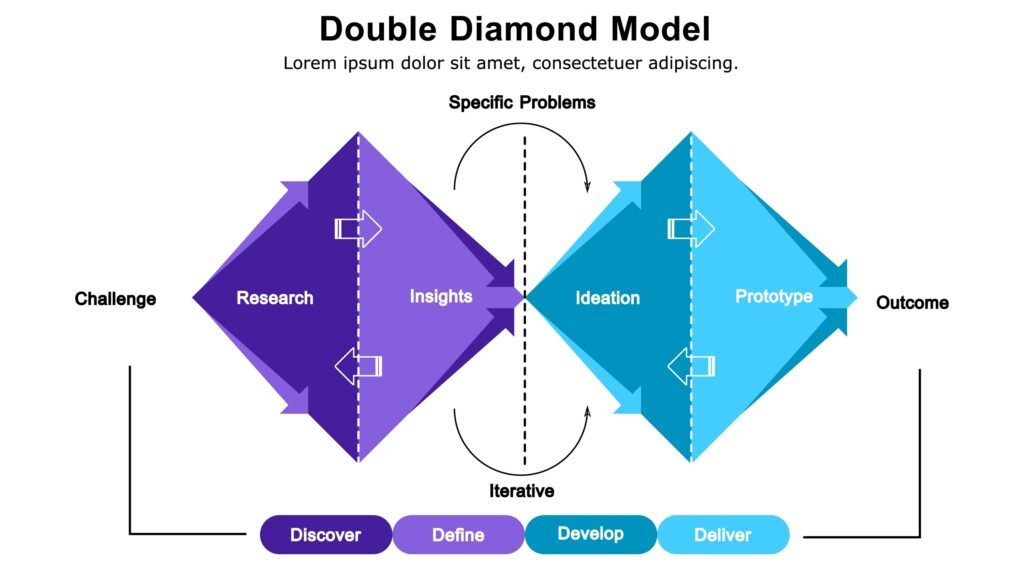
The strategy of Design Thinking is best visualized as the Double Diamond. It represents a process of exploring an issue more widely or deeply (divergent thinking) and then taking focused action (convergent thinking).
| Diamond Phase | Activity | Coaching Goal |
| Discover | Deep User Empathy and research. | Challenge existing assumptions. |
| Define | Synthesizing data into a clear problem. | Establish Stakeholder Alignment. |
| Develop | Ideation and Rapid Prototyping. | Encourage creative risk-taking. |
| Deliver | Testing and final validation. | Ensure Innovation ROI. |
The Playbook: 3 Steps to Implementation
Step 1: Start with "Beginner's Mind"
In the FMCG sector, we often think we know the consumer. Design Thinking forces us to "Empathize" by observing them in their natural habitat—the kitchen, the store, or the office. This is where the most valuable Market Insights are found.
Step 2: Reframe the Problem
Before jumping to solutions, spend time "Defining" the real issue. Instead of "How do we sell more juice?", try "How might we make healthy hydration easier for busy Swiss parents?" This shift changes the entire Innovation Strategy.
Step 3: Prototyping is Thinking
In the service industry, don't just talk about a new customer journey—act it out. Use Lego, sketches, or digital mock-ups to "Prototype" the experience. This tangible approach speeds up Idea Validation and prevents expensive mistakes.
Solutions: 6 Mechanisms for Design Thinking Success
How can you bring this mindset to your Swiss organization tomorrow?
Empathy Maps: Use them to document what users say, do, think, and feel.
- Brainstorming “Sprints”: Time-boxed sessions to generate 100+ ideas for a single HMW question.
- Customer Journey Mapping: Visualizing every touchpoint a customer has with your service.
- Low-Fidelity Prototyping: Building “quick and dirty” models to test concepts immediately.
- User Feedback Loops: Inviting real customers to break your prototypes and tell you why.
- Cross-Functional Squads: Bringing together Marketing, Finance, and IT to solve a single problem.
Watch-Out: Avoiding "Analysis Paralysis"
Design Thinking is a bias toward action, but it can sometimes get stuck in the “Research” phase.
Don’t Over-Research: Empathy is vital, but don’t let it stop you from moving to the “Ideate” phase.
Avoid “Groupthink”: Ensure your brainstorms include diverse voices, including those who are usually quiet.
The Prototype is Not the Product: Don’t fall in love with your prototype. Be ready to “Perish” it if the data shows it’s not working.
Swiss Perfectionism: In Design Thinking, “Rough and Ready” is better than “Perfect and Late.” Embrace the “Good Enough” to learn faster.
Ready to Unlock Your Team's Creative Potential?
Design Thinking is the most powerful way to de-risk innovation in the FMCG and service sectors. It ensures that your brand remains relevant by solving the right problems for the right people. At LeanSparker, I facilitate the workshops and provide the coaching needed to turn this methodology into your team’s new superpower.
Frequently Asked Questions: Navigating the Human Element of Problem Solving
Design Thinking is more than a workshop—it is a way of seeing the world through the lens of possibility. These insights are tailored to help Swiss FMCG and service leaders bridge the gap between abstract creativity and measurable business results.
Question 1: Is Design Thinking too “creative” for a serious service company?
Answer: On the contrary, the most serious companies—from banks to insurance—use it to solve their most rigid problems. It provides a structured way to be creative, which is essential for Business Resilience.
Question 2: How is this different from a normal brainstorm?
Answer: A brainstorm is just one small part (Ideation). Design Thinking starts with User Empathy and ends with Testing, ensuring that the “ideas” are actually based on human needs.
Question 3: We have no “Designers” on staff; can we still do this?
Answer: Absolutely. Design Thinking is a methodology, not a job title. Some of the best design thinkers are in Finance or Operations because they see the “Friction Points” clearly.
Question 4: How long does a Design Thinking cycle take?
Answer: It can be a “Design Sprint” of 5 days, or a more traditional 3-month project. The goal is to move through the stages as fast as possible to reach Validated Learning.
Question 5: How does this link to Lean Startup?
Answer: Design Thinking is the best way to find the “Problem/Solution Fit,” while Lean Startup is the best way to find the “Product/Market Fit.” They work hand-in-hand to maximize Innovation ROI.