The Speed of Learning is Your Greatest Asset
Most traditional businesses follow a “Linear” model: Plan -> Build -> Launch. The problem? You only find out if you were wrong after you’ve spent your entire budget. The Build-Measure-Learn (BML) Loop turns this on its head. It is a fundamental feedback loop designed to turn uncertainty into validated knowledge as quickly as possible.
At LeanSparker, I view the BML loop as the heartbeat of Strategic Curiosity. It isn’t just a process for startups; it is a framework for Business Resilience. By cycling through this loop rapidly, you ensure your Innovation ROI stays high and your team stays focused on what truly creates value for the customer.
Quick Navigation
- What is the BML Loop? The science of iterative growth.
- The Glossary: Hypotheses, Pivots, and Actionable Metrics.
- The Strategy: Breaking down the 3 core phases.
- The 3-Step Playbook: Starting with the end in mind.
- The Solutions: 6 Mechanisms to speed up your cycles.
- Watch-Outs: Avoiding the “Data-Obfuscation” trap.
- FAQ: question: Your questions answered.
Assess Your Knowledge Of Innovation
The Innovation IQ Test: What Lean Sparker Are You?
Ready to assess whether you have the foundational knowledge of innovation used by top industry leaders? Take this fast, 5-question quiz to instantly measure your expertise in Lean Startup, Design Thinking, and building a Growth Mindset.
Definition: What Exactly is the BML Loop?
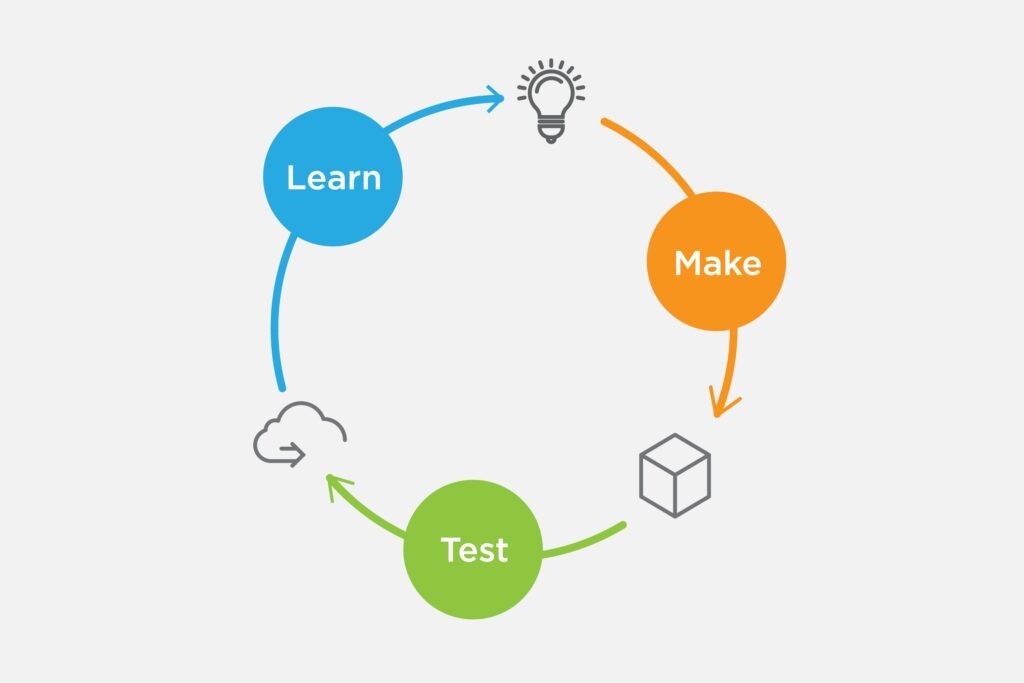
The Build-Measure-Learn loop is the core of the Lean Startup methodology. It starts with a Hypothesis (a “Leap of Faith” assumption) and moves through three distinct stages to test that hypothesis. For a Swiss FMCG brand, this might mean launching a tiny “Smoke Test” for a new beverage in one local coop to see if people actually pick it up before investing in a national bottling run.
The goal is not to finish the loop, but to minimize the total time through it. The faster you cycle, the faster you achieve Idea Validation. This is the ultimate tool for Innovation Pipeline Acceleration, as it allows you to “kill” weak ideas early and double down on the winners based on Market Insights.
Understanding the BML Glossary
To run an effective loop, you need to speak the language:
Hypothesis: A testable statement about how your business will work (e.g., “Mothers in Zurich will pay 20% more for organic baby food”).
Actionable Metrics: Data that links specific actions to results (e.g., “The number of people who clicked ‘Pre-order'”).
Vanity Metrics: Data that makes you feel good but doesn’t track value (e.g., “Total Instagram followers”).
Pivot: A change in strategy based on what you learned (e.g., “They don’t want the food; they want the subscription service”).
Unit of Progress: In BML, the only measure of progress is Validated Learning.
The Strategy: Planning in Reverse
The secret strategy of the BML loop is that you actually plan it in reverse. While you execute Build -> Measure -> Learn, you must plan in the order of Learn -> Measure -> Build.
| Phase | Strategic Action | The Core Question |
| Learn | Identify what you need to know. | What is our biggest “Leap of Faith” assumption? |
| Measure | Decide how to track the result. | What specific data will prove or disprove our guess? |
| Build | Create the MVP to get the data. | What is the smallest thing we can build to start the test? |
By planning backward, you ensure that you don’t build a single feature that doesn’t directly contribute to your Learning Agility.
The Playbook: 3 Steps to Launch Your First Loop
Step 1: State Your "Leap of Faith"
Every project starts with a guess. Write it down clearly. "We believe [Target Audience] will [Action/Purchase] because [Value Proposition]." This is the foundation of your Strategic Curiosity.
Step 2: Define Your "Failure Criteria"
Before you Build, decide what data would make you stop. If fewer than 5% of visitors click your "Sign Up" button, is the idea dead? Setting these benchmarks early ensures Stakeholder Alignment and prevents emotional attachment to a failing idea.
Step 3: Build the "Minimum"
Create the smallest possible version of the idea (an MVP) that allows you to collect the data you defined in Step 2. This is the heart of Agile Innovation—getting a "signal" from the market before you commit to the "noise" of full production.
Solutions: 6 Mechanisms to Speed Up Your Loops
How can you make your BML cycles faster in your Swiss organization?
- Smoke Tests: Use a landing page or a simple ad to see if people are interested before you have a product.
A/B Testing: Simultaneously test two different versions of your value proposition to see which one “Learns” faster.
- Innovation Accounting: Use a dashboard that tracks “Validated Learning” instead of just traditional financial ROI.
- Customer Interviews: Pair your quantitative data (Measure) with qualitative “Why” (Learn) by talking to users.
- Concierge MVP: Manually perform the service to learn the customer’s needs before you build the automation.
- Pivot-or-Persevere Meetings: Schedule a recurring meeting every 4 weeks to review the data and decide on the next loop.
Watch-Out: Avoiding the "Data-Obfuscation" Trap
The biggest threat to the BML loop is ignoring the data when it tells you something you don’t want to hear.
Don’t Fall in Love with Your MVP: It is a tool for learning, not a final product. Be ready to scrap it.
Avoid “Analysis Paralysis”: Don’t spend three months “Measuring.” Get the data you need and move to “Learn” immediately.
Beware of Vanity Metrics: 10,000 “likes” is not Validated Learning. It is a distraction from your Innovation ROI.
Closing the Loop: The loop only counts if you actually Learn and change your behavior. If you build and measure but never change the plan, you are just doing “Waterfall with Charts.”
Ready to Turn Uncertainty into a Competitive Advantage?
The Build-Measure-Learn loop is the most powerful tool for navigating the 2026 market. It protects your budget, empowers your team, and ensures that when you finally “Launch,” you are launching something the market is already waiting for. At LeanSparker, I help you design and facilitate these loops, turning your Market Insights into Business Resilience.
Let’s start the cycle.
Frequently Asked Questions: Navigating the Cycle of Continuous Growth
The BML loop is the heartbeat of any resilient Swiss organization, turning raw data into strategic direction. These insights help FMCG and service leaders understand how to maintain momentum without losing sight of the consumer.
Question 1: How long should one loop take?
Answer: In the Swiss retail or service sectors, you should aim for loops that last between 1 and 4 weeks. Any longer, and you are likely “Building” too much.
Question 2: Can we use BML for internal corporate changes?
Answer: Absolutely. If you are changing an internal process, treat the first department as your “Build” phase and “Measure” their productivity before rolling it out company-wide.
Question 3: What if the “Measure” phase gives us mixed results?
Answer: That’s where Qualitative Research comes in. If the numbers are unclear, go back and talk to the users to find the “Why” behind the “What.”
Question 4: Does BML replace traditional R&D?
Answer: No, it complements it. It ensures that your R&D efforts are focused on features and products that have a proven “Right to Win” in the market.
Question 5: How do we get the Board to care about “Validated Learning”?
Answer: Frame it as Risk Mitigation. Explain that every loop we complete reduces the financial risk of a major “Big Bang” failure.